
Two Controls
Awareness is not mobility, and speech is not freedom.
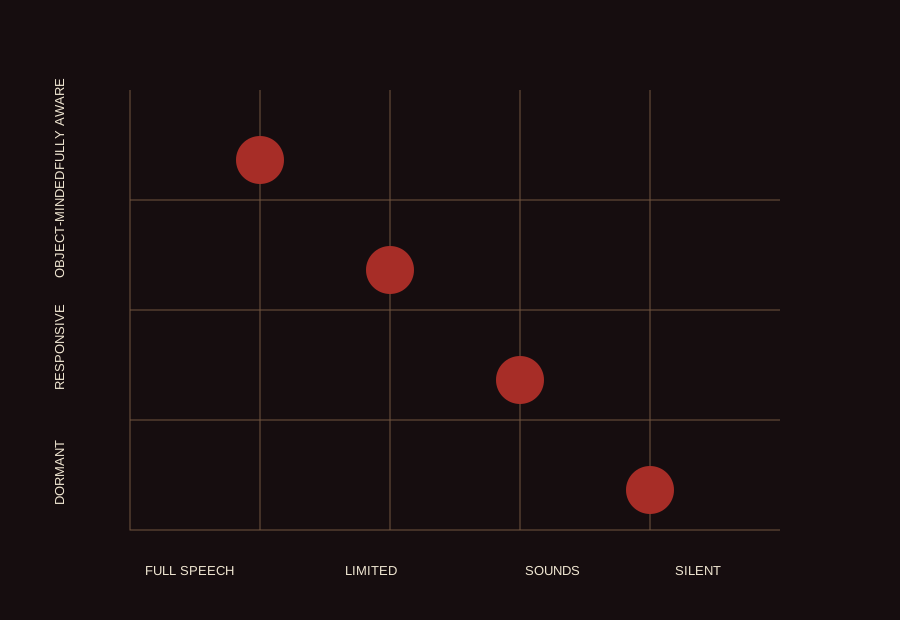
Transformation fiction often becomes less precise when consciousness, movement and consent are treated as one switch. This archive separates them. A form may be fully aware and articulate while permanently mounted. Another may be portable and expressive but able to produce only sounds. A dormant form may have no active experience until a fictional use condition wakes it.
The separation creates sharper stories. Full awareness intensifies observation and anticipation. Reduced awareness can make function feel automatic and restful. Command response makes external language the trigger for the limited actions that remain. Dormancy removes waiting and turns time into discontinuous scenes of activation and storage.
Awareness Spectrum
Five interior states, each with a different pressure.
Fully aware preserves memory, judgement and continuous perception. The character knows the finished condition in full. Aware and object-trained retains that perception while making object address, stillness and use feel learned and expected rather than constantly surprising.
Reduced/object-minded narrows thought toward surface, position and function. Complex planning recedes. Command-responsive organizes awareness around external cues: the form waits, recognizes and answers within a limited response set. Dormant until use turns consciousness off between defined activations.
None of these states is presented as a diagnosis. They are narrative settings for impossible adult fictional forms. A Form Study describes the setting that best supports its story rather than ranking one as more severe or more desirable.
Object Status
The classification changes social grammar.
Object status appears in address, storage and function. “The doll,” “the toy,” “the form” and “the station” do not operate as pronouns in this archive. They are forms of public address that foreground what the transformed character has become. A personal name remains in the dossier so the fiction can preserve continuity without restoring ordinary status.
The Japanese vocabulary of 物品化 is useful here because it points to conversion into an article or thing. The form may be displayed, carried, catalogued or used according to its new category. Its awareness can interpret those acts, but the treatment follows the object classification.
Maintenance
Objectification can include careful keeping.
Severe object status does not require neglect. Cleaning, wrapping, supporting and returning a form to its cradle can reinforce the fantasy by treating maintenance as part of function. The character is not restored to an ordinary body after use; she is maintained as the object she has become.
This also gives non-use scenes weight. A form waiting in a quiet display bay, hearing a cover being removed or recognizing the numbered cradle assigned to her can carry as much objectification as an explicit scene. The completed condition remains active between sexual events.
Object Address
How a form is addressed reveals what awareness is allowed to do.
A personal name preserves continuity, but an object address determines the active scene. “She” may keep the character socially visible. “It,” “the doll,” “the toy,” “the onahole” or “the form” directs attention toward category and function. A Form Study can retain both: Mina in the title, the doll in selected use; Noa in conversation, the station when the room is being configured.
The effect depends on awareness. A fully aware form hears the shift and understands what part of her record has become relevant. An object-minded form may respond more clearly to the catalogue address than to the former name. A command-responsive form may recognize only filed calls. Dormancy may make address the mechanism that begins perception again.
Object address is never a pronoun setting for a real participant on this site. It is authored language inside fixed fiction. That lets the archive use depersonalization as a precise story tool without creating a social identity system or inviting a visitor to apply the term to anyone outside the text.