Silhouette 01
Compact Daruma — centered, portable, severe.
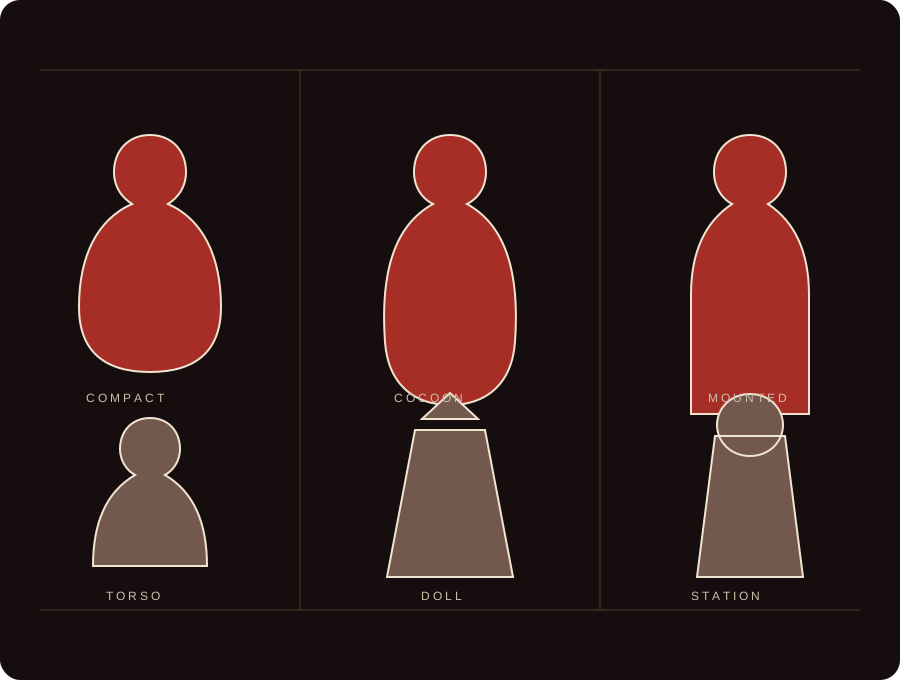
The Compact Daruma gathers the finished character around a single vertical mass. Head, shoulders, breasts, waist and configured lower surface read as one continuous object. There are no articulated extensions to distract from face and access. The visual weight sits low enough that the form can be placed in a cradle, on a broad plinth or against padded storage supports.
This is the archive’s defining silhouette because it makes object status immediate without depending on damage. The form looks designed to be complete at its present boundary. Soft TPE and silicone make it read as a functional toy; lacquer or porcelain can shift the emphasis toward display and ceremonial handling.
Compact forms are normally carried rather than rolled or made to imitate walking. Their position is supplied from outside. That dependency can be gentle, clinical, possessive or humiliating depending on the fiction, but the silhouette itself remains still and symmetrical.
Silhouette 02
Torso form — face and surface held in tension.
A Torso Form keeps more vertical length through the waist and pelvis. It resembles a severe display body without borrowing the rough edges of a broken sculpture. The lower boundary is rounded, sealed or integrated into a base so the design reads as manufactured completion.
The longer surface permits seams, panel lines, material changes and catalogue marks. Vinyl and lacquered synthetic finishes work especially well because reflected lines can describe volume without restoring ordinary mobility. A torso form may be laid horizontally, carried upright or fitted into a transport frame.
Compared with the Compact Daruma, the torso gives the face more distance from the primary access points. That separation can make full speech feel more human, or make a configured mouth feel more deliberate. Eden, D-006, uses this silhouette to explore portable object-minded awareness.
Silhouette 03
Cocoon form — enclosure becomes the outline.
The Cocoon Form does not merely cover the finished character. Encapsulation becomes the finished body. Rubber, latex or another seamless membrane closes the silhouette into a smooth continuous volume, often narrowing around the shoulders and lower form while leaving selected facial or access zones configured.
Suspension and command response suit this silhouette because orientation is supplied by straps, rings or a fictional mounting field rather than by the character. The archive never turns those elements into real restraint instructions. They function as visual grammar: fixed axis, controlled rotation, no autonomous repositioning.
Sable, D-002, uses a cocoon condition to connect 固め-like fixation with object conversion. Her awareness is not erased. It is narrowed into response, sound and the awareness of being held in an assigned position.
Silhouette 04
Doll form — finished for looking before touching.
A Doll Form emphasizes designed beauty, surface perfection and display. The figure may retain a decorative waist, stylized chest and carefully composed face while all articulation has been removed from the final condition. Porcelain, lacquer and vinyl push the form toward 人形化: the character becomes something posed, kept and viewed.
Doll does not automatically mean unconscious. A doll-still face may conceal full awareness, and fixed eyes may be the only available response. Conversely, a beautifully expressive face may be paired with complete silence. The fascination lies in the mismatch between visible personhood and assigned object status.
Iris, D-003, is the clearest display-oriented example. Her form remains private and selective rather than publicly available, showing that objectification and sexual openness are separate classifications.
Silhouette 05
Mounted form — the room becomes part of the body.
A Mounted Form is completed together with a station, plinth, wall frame or fixed support. The object cannot be understood apart from its installation. Height, angle and access are architectural properties rather than postures the character can choose.
This silhouette intensifies the distinction between awareness and agency. Noa, D-004, retains full speech and a fully expressive face, yet cannot change a single spatial relation. The room decides where Users stand and how the form is approached. She can speak about that condition without being able to alter it.
Mounted forms suit technological fabrication and silicone surfaces because the transition between character and station can be seamless. They also support shared-use fiction without implying that every form in the archive has the same availability.