
Method
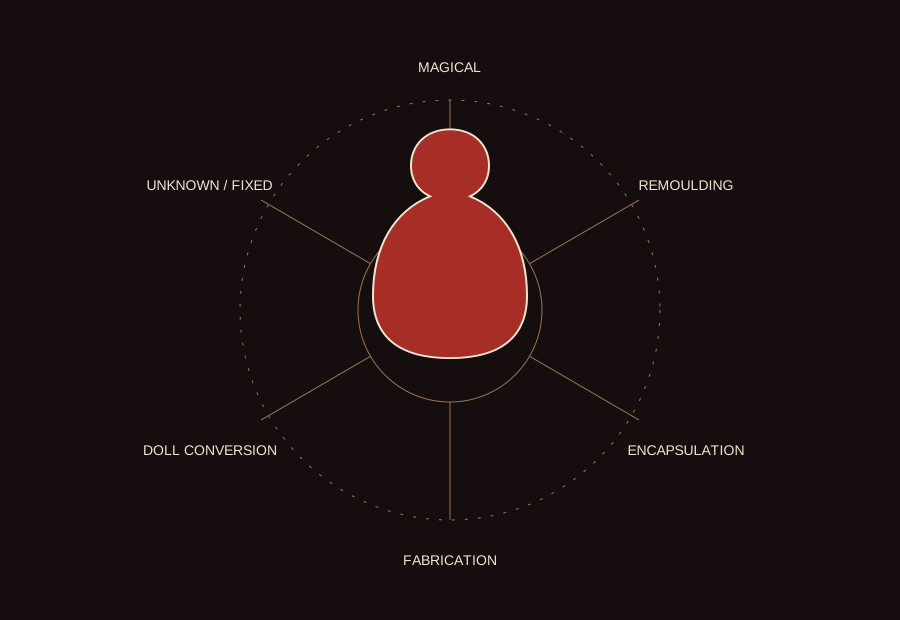
Six ways to arrive at a seamless result.
Magical transformation allows the fastest and most symbolic completion. Flesh can become lacquer, porcelain, rubber or another unified material without a workshop, wound or mechanical explanation. Magic supports sudden status change: one command, contract or spell converts both body and social function.
Synthetic remoulding treats the former body as source material reorganized inside a controlled fictional system. The important verb is remoulded, not removed. Soft TPE or silicone appears continuous because the entire form is recast into one designed object.
Doll conversion emphasizes surface, face and display. It can preserve a stylized likeness while changing scale, articulation and expression. Rubber encapsulation instead makes enclosure the new body, closing motion and identity under one membrane.
Technological fabrication connects the form to a station, protocol or engineered material. It suits mounted designs and explicit configuration records. Unknown or irreversible completion leaves mechanism deliberately unreadable; the archive can document the result without solving its origin.
Premise
Choice, assignment and fictional resistance are different stories.
Self-chosen places desire inside the character before the transformation. Commissioned adds design, specification and an external maker without turning the maker into a public owner. Both premises can still include severe surrender because choosing a permanent object condition is not the same as retaining control afterward.
Assigned makes the completed function part of a fictional institution, contract, judgement or role. The character may have agreed to the world that can assign her without choosing every detail. This is useful for stories about depersonalization and categorical change.
Captured and converted and fictional forced/CNC are fantasy premises for loss of control. They remain fiction at every level of this site. The text can stay in-world, but editorial framing must never turn into a real instruction, a claim about actual consent or a scenario involving a real person.
Completion Rule
The archive begins after transformation mechanics stop.
A method can be dramatic, but the site does not need to illustrate a process to prove that a transformation occurred. Each Form Study opens with a stable result. Earlier stages exist only as narrative memory. That decision keeps the visual identity focused on design instead of anatomy being altered.
Completion also prevents accidental medical logic. No form needs dressings, recovery, rehabilitation or treatment. The new surface is immediately the normal surface of the object. Cleaning, storage and use belong to object maintenance, not clinical aftercare.
Narrative Effect
A method should leave evidence in the finished form.
Method is most useful when it changes how the result feels rather than supplying a decorative origin. Magical conversion can make a lacquered doll seem inevitable, as if a symbolic design has replaced ordinary anatomy in one decision. Synthetic remoulding emphasizes softness, repeatable contours and a form designed to receive pressure. Rubber encapsulation emphasizes enclosure, breath, masked identity and a continuous exterior boundary.
Technological fabrication can join body and station so completely that mounting becomes part of anatomy. Doll conversion can concentrate on finish, display and a face held between expression and sculpted stillness. An unknown method removes process from the record entirely and lets irreversibility be inferred from the consistency of the object now on file.
The same premise changes each method again. A commissioned form reads as deliberate specification; an assigned form reads as classification imposed from outside; a fictional forced/CNC form preserves resistance inside a scenario whose boundaries exist at the level of authored adult fiction. Method produces the object. Premise determines what the character remembers about becoming it.